Tuesday, April 26, 2011

Pacific Northwest Volcanoes: Peak Viewing

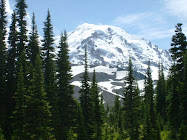
Do you know how many dormant volcanoes there are in the Cascade Range? (Hint: How old were you when you graduated from high school? Bonus points: Name the peak to the left.)

These stunning and dangerous mountains dominate our landscape throughout much of the Northwest. Want to know where to see as many at once as possible?

Best bet: Book a flight from Seattle to the San Francisco Bay Area during the later summer, when chances are best for clear skies on the Left Coast, and get a window seat. (Hey, then you get to be in San Francisco, too!) I always get excited spotting and naming all the volcanoes up and down the coast on this flight, from Lassen in the south to Baker in the north. Once we flew so close over Mount Shasta it looked like an easy jump down into the creamy white bowl of the summit crater.

Second best bet: Climb a volcano near mid-range (Mount Rainier or Mount Hood) for optimum viewing north and south. This is also great incentive to get in good shape!

More realistic bet: Take the gondola or Rainier Express (REX) chairlift to the top of Crystal Mountain on a clear day for the awesome views of most of the Washington peaks. In Oregon, take the Summit chairlift at Mount Bachelor. They say on an exceptionally clear day you can see all the way to Shasta in northern California, although I wasn’t so lucky when I was there last.

So this is really a roundabout way to talk about another fantastic day spring skiing at Crystal Mountain over the weekend, when Cascade (and Olympic Mountain) viewing was incredible. This cloudless day was so overdue because even us mossbacks need occasional glimpses of sunshine and blue skies. (Oy, what a chilly damp spring we’re having!)

From this vantage point at the top of REX we get the rare treat of being able to see every major peak in the state except Glacier Peak, which is hiding behind the non-volcanic Stuart Range on the northern edge of Alpine Lakes Wilderness to the northeast. We’re far enough east here that the summit of Mount Saint Helens is visible peeking up behind the eastern flank of Rainier. (Look carefully, it's in the shot below.)


To the southeast is Mount Adams, the second-highest peak in Washington at over 12,000 feet. (Adams is a relatively easy, nontechnical climb up the south side. You need to be in good shape, though.)


Way up north we can see the more graceful, conical summit of Mount Baker, one of the youngest volcanoes in the range. And over to the west beyond Puget Sound are the Olympics, formed by uplift as the Juan de Fuca plate subducts under the North American continent.

I snap a few photos—not nearly enough. But I don’t want to keep my ski buddies waiting while I fiddle with the camera. I prefer moving with my viewing.

When You Go
If you’re not a skier, you can still take these chairlifts in the summer, or hike up. I’d love to hear your suggestions for optimum volcano viewing! Just leave a comment below.

Friday, April 8, 2011

Crystal Mountain’s South Back: A sweet taste of backcountry skiing


 I’ve been trying to think of a clever way to start this blog post, but here’s the deal:

Crystal Mountain’s South Backcountry rocks.

Skiing Montana recently was wonderful, but I’ll take fresh tracks under blue skies in the South Back almost any day.

A great day in the South Back offers amazing views of hulking Mount Rainier (not much more than spitting distance away) while hiking/traversing the ridge south of the High Campbell chair. Then there are so many steep and steeper pitches of untracked snow deemed relatively safe by the avalanche control crew. (Of course always proceed with caution.)

That’s the beauty of South Back: Hiking out of the lift-served area for a quasi-backcountry experience while knowing that the avalanche crew has checked the conditions and blasted down especially slide-prone slopes and cornices. (For this and all the other hard work the Crystal Ski Patrol folks do, a huge THANK YOU!)


A few weeks ago I was lucky enough to ski Crystal a day after it snowed 8 inches and the South Back was opened for the first time all week. We had plenty of company, but there’s enough terrain out there to go around.

It’s Julie’s first time out in the South Back, and I haven’t been for several years. With mostly blue skies and just light clumps of clouds hovering around some peaks, it’s a stellar day.


We start the first and longest of a few short hikes after traversing as far as we can from the top of Chair 6 (High Campbell), skis off and propped over our shoulders. A trail of skiers and boarders is heading out with us, but everyone is friendly. How can we not be on such a gorgeous day?


After topping out the first hike and traversing above Avalanche Basin, we see several skiers atop Silver King, looking poised to drop into Brain Damage, an hourglass-shaped chute that turns scary steep about halfway down. Not going there today.


Rich points to the spot he shoved off into the basin several weeks ago when he had the place almost to himself. "Eighteen inches of fresh snow, it was amazing," he tells us. (I’m jealous in retrospect, is that possible?)


The traverse is a bit longer than I remember. We pass one poor snowboarder who steps aside to let us pass. He’s been sinking to his knees tromping through the fresh layer of white stuff.

Soon enough, though, we top out above Silver Basin and scope it out. It looks as inviting as a creamy swirl of exquisite Italian gelato, something I'd like to dive into and relish.

An older guy plunges into the basin and proceeds to slice down the slope in even, rhythmic turns. “That’s my dad, he’s 65! Isn’t he awesome!” says a woman standing beside us.


And so it’s time for us to leave our signatures in the snow. Okay,it’s not quite as dreamy fluffy light as the Rocky Mountain pow I just skied in Montana, but it’s still great fun. So much fun that the camera stayed in my pocket. But I did stop at the bottom to capture our tracks. See mine there over to the right? :)


When You Go
Since the day a few weeks ago chronicled in this blog post, Crystal experienced some major slab avalanches. Check the Crystal Ski Patrol blog for the latest. And if you head for the hike-to terrain in the South Backcountry, don’t go alone, especially if you are not familiar with the terrain! A couple years ago two enterprising high school guys prepared a guide to Crystal’s South Backcountry (apparently as part of a high school project).

Crystal will be open into mid-June this year owing to the snowpack, so there's still plenty of time to get out there! And because I was too wrapped up in skiing to film, here's a link to film shots of skiing in the South Backcountry.

Thursday, March 31, 2011

Northwest Flavors: Snorting Elk Deli's Crocodile Spice Cookies

Have you ever had an unforgettably delicious cookie that made you ignore common sense and turn into a raving cookie monster?

“Me want cookie!”

Yea, I thought so. Me too.

I discovered that special cookie at, of all places, an out-of-the-way, postage-stamp-sized deli tucked in the back of a pub at a downhill ski area.

Crystal Mountain skiers who’ve made it past the bar and snarfed down Snorting Elk Deli’s amazing cookies instead of (or in addition to) beer and pizza know what I’m talking about. Maybe your favorite is the chocolate espresso or another Snorting Elk cookie since they’re all so tasty…but my cookie fixation is the crocodile spice.

David, a friendly twenty something who works in the deli, doesn’t know exactly who came up with the recipe or how long they’ve been around. When I tell him I remember crocodile spice cookies from my years as a ski instructor at Crystal in the early 1990s, he says “Wow, I was only three years old then!” (Ah, nothing like being reminded that you are not a youngster anymore.)

What I do know is that these cookies are unique to Snorting Elk. “You can’t get these cookies anywhere else,” David tells me. (Indeed, I did a Google search for crocodile spice and got no hits.)

So what makes crocodile spice cookies so wonderful? Think of the perfect chewy-yet-crisp chocolate chip cookie, then throw in strong hints of cinnamon and ginger, toasted walnuts, and a generous sprinkling of powdered sugar.

Sounds simple, huh? But it’s a brilliant combination, in my seasoned cookie-loving opinion. I’d call it an exotic-rustic treasure of a cookie.

When I ask David if they’ll give up the recipe, I get the answer I expected: “No.”

Silly me. But at least he’s nice about it.

“The recipe has evolved over the years.” He tells me Lindsey the baker starts at 4 a.m. every morning during the ski season making cookies and other goodies in the Snorting Elk kitchen. I’d personally like to thank Lindsey for doing a superb job!


Of course I just have to see if I can replicate the crocodile spice in my kitchen. I start with a modified Tollhouse recipe, but make numerous tweaks.

The results? Not bad. Not the real deal, but close enough to try if you can’t make it to Crystal in the next few weeks. I think I overdid it a little on the spices, so I’m reducing the amount a teeny bit here. This makes about two dozen cookies, depending on how big you like them.

Mock Croc Spice Cookies

Mix the following dry ingredients in a medium bowl:
1 cup whole wheat pastry flour
1 cup unbleached white flour
½ tsp baking soda
Touch of salt
1 tablespoon ground cinnamon
1 tablespoon ginger


Cream in a larger bowl:
8 oz unsalted butter
8 T unbleached sugar
4 T dark brown sugar
½ tsp vanilla
Mix in 1 large egg

Slowly stir in dry ingredients into the sugar/butter mix, then stir in:
½ cup semi-sweet chocolate chips
½ cup milk chocolate chips or small chunks from a baking chocolate bar
½ cup chopped walnuts


Bake for 8 minutes in preheated oven at 350 degrees.

After cooling for a few minutes on a rack, spoon some powdered sugar atop each cookie and smear across the top.

Cookie Monster Details
David says Snorting Elk Deli will only for sure be offering their cookies through the regular downhill ski season ending April 17 this year, although they might extend into late-season spring skiing, which starts in late April and goes into early June.

To find Snorting Elk Deli, cross the wooden bridge just below the base lodge complex on the south side of the upper parking lot and follow the footprints in the snow to the bar entrance. Inside, go left past the first few booths, then right and walk past the fireplace straight to the back, where you’ll see the deli entrance. If you want to get a cookie, go early! Cookies go on sale at 11 a.m. and usually sell out by mid-afternoon. BTW, Snorting Elk Deli has great soups and sandwiches too.

Friday, March 25, 2011

Skiing Whitefish: Big Mountain, Big Fun

With stunning Rocky Mountain panoramas that make you gasp for their grandeur, Whitefish Mountain Resort in northwest Montana is worth the trip just for the lift ride to the top. But c’mon, what really lures us skiers and snowboarders here is the abundant and great snow, varied and expansive terrain, and the friendly Montana vibe.

We almost didn’t go today because from Flathead Valley the mountain looked socked in with dark clouds. Good thing we did, though. By the time we arrive after the short drive uphill from the town of Whitefish, the clouds are starting to dissipate and it’s snowing just lightly.

Although it’s March, we’re bundled up for midwinter conditions. This is the northern Rockies after all.
As we near the top of Chair 1/Big Mountain Express, we pass eerie clusters of snow ghosts, trees caked in a hard icy rime.

While snow clouds are still drifting low overhead, the Flathead Valley opens up below as a huge patchwork of blue and white. I feel like we’re in the cockpit of an airplane, ready to fly.

“Let’s start with a blue cruiser run down the front side,” says our local host Allison. And so begins a great day of skiing.


After our first run, snow starts falling again as we head back up Chair 1 and then down the north side. Over here the snow is lighter and fluffier. We ski down the mellow Gray Wolf traverse, but as we skirt past steep drop-offs into untracked snow and trees, I can’t resist.

“Hey, are you guys game?” And then I plunge down into the trees with a big smile.

We’re all game today.

Every run on the north side is wonderful powder or packed powder today, so we work up quite an appetite for lunch. “Lunch at Hellroaring today,” instructs Allison as we follow her down.

Rustic and cozy Hellroaring Saloon is in the original timber lodge built here in the 1940s. Allison tells us that the new resort owners threatened to tear it down, but the locals set them straight. I love these old wood-timbered ski lodges.

We snag some seats at the bar and have a very tasty lunch (green salad, tuna sandwiches, and chili). We also get some good tips on where to ski from our friendly bartender, an Oregon transplant who has been here over 20 years.

With a taste of tree skiing in the morning, we decide to try the longer, steeper Connie’s Coulee glade into Hellroaring Basin next. We pick our way through the trees in the tracks of others until we find a few open glades to carve up.

“Uff da!” I hear Julie cry a few times on the way down. We decide it’s not quite as fun as our morning, but the runout down Glory Hole through the forest is beautiful as the sun finally breaks through for good.

Although I know it’s too early, I can’t help but glance around for signs of grizzly bears as we ski through the basin. In not much more than a month, the slumbering grizzly bears that hibernate in this basin will be starting to wake up and emerge.

For our last run of the day we start down Inspiration on the front side, where it looks like we could just ski jump right off the mountain and land in the valley far below. Off to the east, the dramatic glacier-scoured peaks of Glacier National Park are now visible, making the backdrop even more stunning.


After passing Schmidt’s Chute, we drop down north-facing, black diamond Elephant’s Graveyard, which today is lightly bumped with soft, fresh snow. Very sweet.

“This is so fun!” I find myself shouting to no one, anyone, or maybe just the sky.

Then it’s the long runout along Expressway on the lower mountain back to the base lodge. Us urban dwellers from west of the Cascades are tired after a full day skiing this Big Mountain, but it’s a good tired.


When You Go
If you want to enjoy Big Mountain this season, go right away! The mountain closes April 1 to protect the grizzlies in the Hellroaring area coming out of hibernation. Whitefish is a doable day’s drive from Seattle (9 hours or so), but you can fly into Flathead Valley (direct flights from Seattle, Minneapolis, and a few other spots) or cooler yet, take the train from Portland or Seattle.

Saturday, March 19, 2011

Living in Cascadia: When will the next megaquake strike?

Let’s face it: Geology happens.

And it has been happening for millions of years, well before humans were around to conceive religion and creation myths. What better reminder than the recent devastating quake and tsunami in Japan.

Are you prepared?

Here in the Pacific Northwest, we’re living on borrowed time, really. It’s just a coincidence or quirk of fate that our region has become more settled, populated, and developed in a period of quiet between the massive subduction quakes that regularly rock our region every several centuries. Just like the 9.0 quake that struck Japan, only probably bigger and closer to major cities like Seattle, Vancouver, B.C., and Portland, Oregon.

I’ll admit to being a bit of an earthquake geek when it comes to our region. It all started back in Geology 101 (Rocks for Jocks) and then Geology 345 (Geology of the Pacific Northwest) at the U Dub, a.k.a., University of Washington. We were introduced to what was then still a theory of plate tectonics, and explored the region in search of ancient mudflows from volcanoes and faults from past earthquakes. What a geologically active and great region to study geology!

Since then, with better technology, scientists are learning that our region is absolutely riddled with active earthquake faults, besides the Cascadia subduction zone that lies just off the coast, from northern California to B.C.’s Vancouver Island. (Note that our volcanoes parallel this zone, from Mt. Lassen in north Cali to Garibaldi and Mount Meager in southern B.C.) Not only does the Seattle Fault run for miles just south of downtown Seattle, geologists have discovered that the South Whidbey Fault runs all way from Puget Sound across the Cascades Mountains into eastern Washington.

So it’s not a question of if, but when the next HUGE ones will happen. The geologic record shows at least 18 subduction zone quakes over the last 10,000 years (maybe more, I just read 41 instead of 18, yikes!). That’s close to one every 240 to 500 years, megaquakes bigger and longer than the recent Japanese quake. The last one was 311 years ago. Ironically, we know the exact date because a tsunami from our quake hit Japan and was recorded at a Zen monastery.

The biggest stratovolcano in the Cascades.

The whole 600 miles of the Juan de Fuca plate slips (subducts) under the continental plate and causes earthquakes that can last up to 6 minutes or longer. The Japanese plate that slipped was just less than 200 miles.

So what can we do besides move to Nebraska? We can appreciate the stunning natural beauty that these geologic forces have forged in our region, such as the Cascade volcanoes and the Olympic Mountains. Then get as prepared as you can. Beyond that, well, we can’t live in constant fear of something that might not happen for another 100 years (although it could happen in the next 5 minutes).


Here are some links to websites that discuss earthquake preparedness. I’ve done basic things like get my house bolted to the foundation, the hot water heater strapped to the wall, and an earthquake shutoff valve installed on the natural gas line that runs into my house. I keep several gallons of water on hand that I empty and refill every month or so, and keep some nonperishable food around. And I just got batteries for my bedside radio since there would likely be no electricity after a big quake. Oh, I also have a first aid kit.


One thing we can appreciate is that we only have one active nuclear power plant in the Northwest, and that’s in the Tri-Cities, definitely not in harm’s way from a tsunami.

So do what you can to learn and prepare as much as possible. Then live right now!

Tuesday, March 8, 2011

Skiing Montana: Havin’ a Blast at Blacktail Mountain

Sometimes in a lucky skier’s or snowboarder’s life, everything converges to create a perfect storm of ideal conditions. Say a storm cell stalls right above the mountain where you’re skiing and dumps fluffy dry snow most of the day. Lots of people decide to stay home or ski elsewhere. And you’re with simpatico buddies who enjoy skiing the same pace and slopes.

Good karma or just good luck? I can’t say for sure, but today I'm one of those lucky skiers.

We’re riding up Chair 1 on this cold, snowy day at Blacktail Mountain when Allison turns to me and exclaims the understatement of the day.

“I Iike to ski.”

With fresh Rocky Mountain powder falling fast and piling up on the slopes, and beautiful glades of uncut snow almost all to ourselves, we are over the moon about skiing. Every run we’ve been whooping, shouting, and laughing out loud about this incredible day.

Skiing at Blacktail Mountain seems just what the doctor might have ordered. After a nasty flu bug, I’m skiing on adrenaline because in the last 40 hours I’ve only eaten a half a banana. But I knew if I dragged myself up here I’d feel better.

And you know what? I feel fantastic! (Okay, I’m pretty pooped later in the evening.)


Blacktail is not a destination resort by any stretch. It’s a small, family-run operation just 14 miles up a mostly gravel road above the northwestern edge of Flathead Lake. But sometimes these local operations can be little gems when the conditions are just right and the crowds are thin.

Like today.

Blacktail, which opened in the mid-1990s, caters to locals around Flathead Valley. But it’s also a nice place to dial down a bit and chill-ax after a long day of hard skiing at Whitefish/Big Mountain up the valley (see an upcoming blog post about that). Most of Blacktail’s terrain is intermediate, but with amazing and abundant snow (an average of 250 inches annually), it makes for a fun day trip.

When we leave the valley floor, the weather is mostly clear, but a mile or so below the top it starts snowing hard. A beauty of Blacktail is driving and parking at the 6,780’ summit and skiing down from there. Take your first run without hopping on a lift! Another great feature is the north-facing runs, which skiers/riders know keeps snow colder and a better consistency.

Allison lives close by and knows the mountain well. “How about we ski Chair 1?” she suggests.

Our warm-up run is a blue cruiser down a wide swath cut through the forest. With the snow coming down nonstop, the base is truly packed powder (unlike so many ski reports in the western Northwest that fib “packed powder” on their ski reports).

Then we move on to the black diamond runs: The Glades, Ponchelon’s Powder (aptly named today), and Badrock. To be honest, by bigger mountain standards, these runs are pretty mellow for black diamond.

The Glades was recently thinned, so for tree skiing it’s not scary at all. We pick our lines and drop off the cat track into the trees below. On the first run, the underlying snow is a little chunky under a few inches of fresh fluff, but throughout the next few hours it snows 6 more inches and turns into a powder hound’s dream.


Amazingly, we have these runs almost to ourselves all afternoon. Run after run just keeps getting better and better. To keep things moving, we only ski to midway on Chair 1 and then hop back on for the shorter ride to the top (no high-speed quads here).

With the snow coming down so thick and fast, but no wind, it’s truly a magical day. Every single run we get fresh tracks in the silky light snow.


It really doesn’t get much better than this. May you, too, be so lucky to catch such a perfect storm.

When You Go
Here's a map showing how to get to Blacktail Mountain Ski Area, which stays open into April each season. It’s closed on Mondays and Tuesdays, so Wednesday mornings can be pretty awesome. Lift tickets are a mere $36/day for adults and only $25 on Thursdays. Special thanks to Allison for being a great host/guide and Julie for taking and letting me use some her great photos for today's post.

Hey, I’d love to read your comments below about a great powder day you might have had!

Friday, February 25, 2011

Skiing Snoqualmie Pass: It’s not always SnoCrummie

I like to think of Snoqualmie Pass (a.k.a. the Summit at Snoqualmie) as Northwest grunge skiing.

It’s about 1,000 feet lower in elevation than most other Washington ski areas and often lives up to its nickname: Snocrummie. And it doesn’t have nearly the size or vertical of Stevens Pass and Crystal Mountain, also easy day trips from the Seattle area.

So what’s to love?

On a good day when the snow is fresh, the freezing level hasn’t risen yet (it will soon), and the sun shines, Alpental is an expert skier’s dream. In part because it is so close to Seattle and not a destination resort, Alpental’s hidden chutes, accessible backcountry, and varied terrain are local Northwest skiers’ private playground. (Well, private is a bit of an exaggeration since thousands of Seattle area skiers and riders play there each season.)

Tucked away up a hidden valley off Interstate 90 near the Alpine Lakes Wilderness boundary, Alpental feels alternately cozy and thrilling. While I’m not a hard core Alpental skier, I’ve been there enough over the years to have experienced some truly awful skiing conditions (icy, rocky) and exhilarating times (fresh pow, gorgeous views).

Alas, I wasn’t able to sneak away from work yesterday to make tracks in the foot+ of fresh, cold snow at Snoqualmie Pass (“The best day at Alpental I’ve ever had!” gushed a mutual friend… sigh), but I did enjoy one of my best days ever at Alpental last weekend.

We pull into the uppermost parking lot early enough to get a good spot—good enough to ski down to the lift from the car and then to ski back to the car. Really, parking doesn’t get any better than this.

Sunshine, electric blue sky, and decent snow make for a great day skiing. We warm up with a run down the tree-lined gully that is Debbie’s Gold (named after Olympic gold medalist Debbie Armstrong, who grew up skiing and racing at Alpental), then head up Chair 2 to the top.

With an amazing, glorious 360° view from the top, I have to stop and gape. To the north, volcano Glacier Peak rises above the rugged, lesser Cascade peaks of Alpine Lakes Wilderness. Southeast, Lake Keechelus shimmers light blue against the darker blue mountains, and southward Mount Rainier is partially visible above Denny Mountain. Sinuous tracks slice through Sharon Bowl in the backcountry just northwest beyond upper International.


Since there’s not much of a lift line yet on Chair 2, we take a couple quick runs down Edelweiss Bowl, a nice mix of short but fairly steep up top that mellows to a good cruiser run. Between our first and second run, the snow softens up a bit.

While it’s a cold day, with temps in the 20s, we get plenty warm skiing down International, Alpental’s premier black diamond run. After a short stretch of bumps to the lip, there’s no choice but to plunge right in to the very steep, usually icy entrance. At first I sideslip tentatively and do a little whining until Rich says “You just have to straighten your skis and drop in.”


Done. And then the fun really begins.

North-facing upper and lower International (“Nash” to locals) stays shaded enough that the snow is usually pretty nice up here. Unless of course it warms up (yes, it will) and then freezes again. But the pitch is consistent and steep, but not too steep, and long enough for some great skiing.

Aaahhhh kind of skiing. Big-smile-evoking skiing.

Today we don’t continue traversing across International into the backcountry, but I see some nice tracks out there. A slight downside to the backcountry is the narrow, sometimes harrowing runout at the bottom.

Regardless, it’s a marvelous day with marvelous skiing and scenery. Sure, Alpental doesn’t have the scope of a larger mountain, but it’s got it all in a more compact form and breeds great skiers.


When You Go
Just go! Preferably on a weekday when the crowds are down. Alpental is about 50 miles east of Seattle off I-90’s Exit 52. If you’re coming from the west, take a left at the exit. At $58/day for adults, tickets at the Summit are slightly cheaper than at Stevens or Crystal.