Wednesday, May 26, 2010

Seattle Asian Art Museum: Fleeting Beauty Persists


Don’t you agree that a life full of contrasts is ultimately most satisfying?

In this spirit, I follow my swinging pendulum of interests, which today points to the visual arts instead of my more usual outdoorsy bent. (Occasionally even I forget that I have an art history degree.)

My destination is the Fleeting Beauty: Japanese Woodblock Prints exhibit at the Seattle Asian Art Museum. This show features exquisite examples of prints from the eighteenth and nineteenth centuries, before the influence of western culture seeped into everyday Japanese life.

Tucked up in historic Volunteer Park on north Capitol Hill, the SAAM (as opposed to SAM on First Avenue in downtown Seattle) is one of Seattle’s architectural and artistic treasures. The clean lines of the original Seattle Art Museum’s Art Deco façade contrast sharply with the voluptuous mature horse chestnut trees and rhododendrons in the park. The overall effect reminds me of an eccentric English countryside manor set in rambling grounds, complete with a glass conservatory full of exotic plants.


And of course there’s that great view as you stand at the museum entrance looking west. The Olympic Mountains loom like an upended serrated knife on the western horizon beyond Puget Sound, the Space Needle, an old reservoir in the park, and the famous Isamu Noguchi Black Sun sculpture (commonly called the black donut).


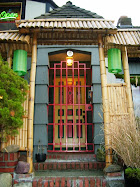
I pass through the lovely wrought-iron entry doors and pay what I think is a bargain ($7) donation fee compared to many metropolitan museums. Although most of the galleries are small compared to bigger, high-ceiling museums, the scale is intimate and inviting.


Fleeting Beauty encompasses several galleries in the interior of the museum, with rich goldenrod-colored walls setting off the many fine woodblock prints. The exhibit theme is ukiyo-e, which translates to “floating world,” and thus captures images of fleeting beauty such as seasonal landscapes, kabuki theater actors, and famous geishas— things apart from mundane and everyday life.

Among the prints on display are several well-known images of Mount Fuji by master print artist Katsushika Hokusai from his series Thirty-Six Views of Mount Fuji (except this series contains over 46 views of the iconic mountain). Two of Hokusai’s “greatest hits”—The Wall of the Wave off Kanagawa and Red Fuji are here in fine form. SAAM is fortunate to have these as part of their permanent collection. (Taking photos are not allowed in the exhibit, so I snapped a reproduction in the art education exhibit.)


As I study the carefully, beautifully rendered prints of times, people, and places long past, I remember a term from the Japanese Art History course I took in college that perfectly captures what I’m feeling: mono no aware. I experience this beauty with an awareness of the transience of all things, and hint of pathos at their passing.

Ultimately mono no aware, and the art and culture of Japan, is rooted in Zen Buddhism and refers to the fleeting nature of beauty, which is all the more sharply sweet because of its impermanence.

Fortunately for us, the beauty of this art is still available and in good care at SAAM.

When You Go
Here is a map of where the SAAM is located. The museum is closed on Mondays and Tuesdays, but is open until 9 pm on Thursdays. Normal hours are 10 a.m. until 5 p.m. Parking is free! But then, so is bicycling. The Fleeting Beauty show runs until July 4, 2010.

Tuesday, May 18, 2010

Mount Saint Helens: Remembering a Former Beauty Queen


Surely you’ve heard it’s the  anniversary of the cataclysmic eruption of Mount Saint Helens.  More accurately, the top of the mountain collapsed, releasing a massive slide and pyroclastic cloud of superheated ash. What was it like that day?

It was a fearsome, awesome spectacle. A once in several generations of lifetimes event.

And although I grew up with a peek-a-boo view of Saint Helens’ summit from my childhood home and a passionate love of her conical white beauty, I didn’t witness the eruption. I was in Boston at that period in my life.

When I heard the news, I called my parents in Troutdale, Oregon, who excitedly described watching it spew a huge cloud into the sky. My dad was at church when the initial eruption occurred and heard a loud boom that rattled the windows.

The East Coast media was all confused. Several papers placed Mount Saint Helens in Oregon instead of Washington, probably because it was so visible from Portland. My friends in Seattle didn’t hear it and couldn’t really see what was going on that far south.

Fifty-seven people perished in the blast, including a guy I knew as a kid. My brother knew David Johnston, the geologist who died in the blast and namesake of the observatory, while at the University of Washington Geology Department.

For me, the eruption was like a mutilation. The most beautiful and graceful-looking of the Cascade volcanoes changed in an instant to a blown out, hulking lump of steaming rock and ash.


Before that May morning, Mount Saint Helens served as a backdrop to many memorable moments in my young life.

One sunset just a few years before the eruption stands out. While my high school sweetheart and I sat (yes, just sat) in an alpine meadow on the slopes of Mount Hood (at Elk Cove, to be exact), Saint Helens slowly changed in hue from white to strawberry ice cream-pink to dusky blue on the northern horizon about 50 or 60 miles away. It was a magical display.

Since then I’ve hiked up to the blown off summit rim and peered down into the gaping, open maw of the blown out crater. It’s impossible to conceive of the force of the eruption while you’re standing there.


But I highly recommend making that trip sometime. Outside of Hawaii, there are only a few places on the planet where you can get so up close and personal to an active volcano.


When You Go
Check here for conditions and how to get a permit to climb to the summit of Mount Saint Helens. Photo credit to the U.S. Geological Survey/Robert Kimmel (top photo).

Saturday, May 8, 2010

Seattle’s International District: A Taste of Asia


I can’t think of a much better way to spend a day than getting together with a couple of my best buds to enjoy Seattle’s historic International District. While our Chinatown (a.k.a. the International District) is not as big or flashy as San Francisco’s, it’s still large and diverse enough to offer an enticing day of tasting and exploring.

Since the late nineteenth century this district just south of downtown has been a melting pot of Asian immigrants—first Chinese, then Japanese, Filipinos, and Pacific Islanders settled here. The Japantown portion of the district foundered during Word World II when most of Seattle’s Japanese-American residents were sent away to internment camps east of the mountains. These days the ethnic mix is diverse, with mainland Chinese, Taiwanese, Vietnamese, Korean, and some remnant Japanese businesses lining the streets.

Today we start with dim sum at Jade Garden, a crowded, noisy, boisterous spot on weekend mornings where the clientele is a mix of scarlet-robed Buddhist monks, Asian-American families, and the rest of us.


Waiting guests usually spill out onto the street, but since it’s chilly out, we’re smashed together in the small lobby against tanks of anxious crustaceans awaiting their demise. I notice a little shrine tucked away in a tiny alcove at the base of a wall near the entrance. It evokes an aura of Asian authenticity and mystery.


As soon as we’re seated the waiters start foisting little plates of food on us.


Steaming shrimp dumplings, glistening baked hum bow, brilliant green baby broccoli, fried rice, noodles…..it’s hard to say no to any of it.


And it’s mostly quite tasty.

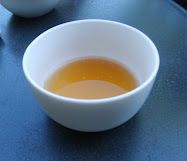
Although we get a big pot of green tea right away, we have to be persistent to get a glass of water. When the check comes, I'm always surprised at how cheap it is. (Today it's $33 for three of us with tax and tip.)

After dim sum we walk down the street past aging brick buildings, herb shops, and more Chinese restaurants to New Century Tea Gallery. This cozy little shop is warm and bright, with shelves stuffed high with teapots, big jars of loose tea, and other tea accoutrements.


Proprietor Grace Chen, who works here with her husband Dafe Chen, invites us to sit down and taste some fine Chinese tea. She notices my friend Mary’s fingers are purple with cold. “You shouldn’t drink green tea, it’s cooling. You need a pu-erh (fermented black tea) that warms you.”


New Century also has a little shrine, which is newer and better-tended than the one at Jade Garden. Grace tells me such a shrine is common at Chinese businesses and it's for the earth or land god.


Next we scoot down a couple blocks to Uwajimaya, the Asian superstore. Years ago this was a smaller Japanese grocery, but now it has morphed into a much larger complex connected to an indoor food court of fast Asian food.


This is the place to go for all your Asian cooking needs like mushroom soy sauce, a zillion different types of noodles, and produce I don't recognize.


A few blocks north on Jackson Street, the main road that bisects the district, we stop in a couple shops in the former Japantown. Momo’s gallery-boutique has a wonderful, eclectic mix of contemporary fashion wear, antique sake jugs, jewelry, and interesting knick knacks. Next door is Kobo, which sells beautiful hand-crafted Japanese artwork and crafts mixed in with historic remnants of its past as Higo's General Store.


We finish the afternoon with tea at the Panama Hotel Teahouse. (Have you figured out yet that I love my tea like Seattle's java junkies love their coffee?) Recently featured in the novel The Hotel at the Corner of Bitter and Sweet, the Panama is a lovely, quiet spot to sip a pot of fragrant tea. (My favorite is genmaicha.)

Exposed brick walls in the long, narrow space are lined with old black and white photos of the neighborhood before World War II, when it was a thriving Japanese-American community.


At the counter I notice petite little cake-like sweets called manju, a Japanese delicacy made with precision and care by Chika Tokara in her shop on Phinney Ridge. We order one to share. Nibbling the exquisite treat between sips of tea is a transcendent experience—the perfect sendoff for a perfect day.

When You Go
Check to make sure there’s not a Seattle Mariners or Seahawks game in town before heading to the International District. Finding a parking spot on a weekend day can be tricky. Better yet, take the bus or walk from downtown. If you can, try a week day to avoid the crowds. There’s so much more to write about the I.D. – watch for another post here on Pacific Northwest Seasons!

Friday, April 16, 2010

McMenamins Edgefield: Kick Back and Party in Troutdale


Urban Portland gets all the fawning media attention, but if you want an authentic Oregon weekend for less $$ than downtown, head east to McMenamins Edgefield in Troutdale on the western edge of the Columbia Gorge.

Sometimes when you’re not paying attention, the unexciting small town where you grew up can evolve into a truly interesting place.

Consider Troutdale, Oregon.

When I was in elementary school, the school bus passed by a forlorn collection of institutional brick buildings near “downtown” Troutdale. It housed a nursing home and, before that, the Poor Farm. The place gave us kids the creeps, and I vowed never to end up there. In fact, the Edgefield was built to house the indigent and poor of Multnomah County back in 1911.

In the early 1990s when the Edgefield was threatened with demolition, the visionary McMenamin brothers saw its potential as a fun and lively destination. They reclaimed the facility and renovated it in a quirky, artsy, funky, comfy style. Similar to historic Timberline Lodge on Mt. Hood, many local artists were recruited to paint and decorate in unique flourishes.

Today the Edgefield features overnight lodging, a winery, distillery, brew pub, cinema, pool hall, spa, soaking pool, concert venue, nice restaurant, tea house bar, golf course, artist glass and pottery studio, herb garden, and more. Besides guests like me who stop by for a meal or an overnight getaway, lots of weddings and events and festivals take place there. It’s always a party!

So after all those years since grade school, I have ended up at the Edgefield–more than once in fact.

On a recent visit, I check in shortly after 3 p.m. and discover I’ve lucked out with an room upstairs in the southwest corner of the main building. Although many lower- to mid-priced rooms share communal bathrooms, my spacious room has its own bathroom (sans shower).

My tentative plan is to get settled, then head into downtown Portland and meet a friend for the evening.

Didn’t happen.

I take a short stroll over to check out Ruby’s Spa, passing the cute little wood and glass tea house bar.

“Do you have an opening for a facial or massage this afternoon?” I ask the two attractive young women behind the counter.

“We do!” Lucky me, it’s a weekday and not too busy.

I indulge myself with a Rejuvenating Facial. Under a soothing mist of steam, my friendly aesthetician Cynthia slathers on my face and decolletage an exfoliating mask, smooth gels, and cool lotions. While she pampers my skin with all-natural Eminence Organics products, I get whiffs of citrus, sweet floral plumeria, and lavender.

Afterwards, I ease into the large outdoor soaking pool next to the spa building and relax even more. Right now I just don’t feel the need to hop in my car and drive 15 miles to a busy, crowded city. The snow-covered Cascade foothills across the Columbia River look just fine from the warm pool.

Then I lounge on the balcony outside my room, overlooking a grove of trees.

By 7:30 I am getting hungry. First I pop my head into the Power Station Pub behind the main inn. It’s a bit too crowded and noisy for me after my spa splurge. Instead I grab a table in the warm and cozy, wood-paneled Black Rabbit Bar.

With a focus on seasonal, fresh food and herbs from local onsite gardens, meals at the Black Rabbit are generally excellent. Tonight is no exception. I get a generous green salad dressed lightly with a tart-sweet balsamic vinaigrette, followed by a spring asparagus risotto topped with a bright green crown of delicate watercress. A glass of Edgefield’s own Willamette Valley Pinot Gris is a perfect pairing with the green-centric meal.

There’s live music in the winery, but since I’ll be up early tomorrow morning (spring skiing) I wander back up to my room. Within 30 minutes of reading in the comfy bed, I drift off to sleep. Early-to-bed, light sleepers take note: bring earplugs–the rooms aren’t that soundproof and the sound of the hallway door opening and closing woke me up several times.

I’m up and out early. Another great thing about the Edgefield is its proximity to dramatic scenic landscapes in the Columbia River Gorge National Scenic Area, which begins just a few miles down the road beyond Troutdale’s old main street.

When You Go
Rooms range from hostel-style at under $50/night to suites with private baths at $150/night. I paid $80/night for my large room. My facial was $95 for 60 minutes. Dinner with wine was under $25 in the Black Rabbit Bar. The Edgefield is right off Halsey Street just a mile or so east of Wood Village and west of downtown Troutdale. It’s easy to reach off of Interstate 84.

Saturday, April 3, 2010

Late Season at Mt. Hood’s Ski Bowl: Plenty of Snow, Cheap Tickets


Hey Northwest skiers and riders, what are you doing today? There’s tons of fresh snow in the Cascades. Lift tickets are a mere $25/day at Ski Bowl.

What are you waiting for? Go on and get up there.

Let’s face it—it hasn’t been the best ski season here in the Northwest. Whether climate change in general or simply El Nino is to blame, we’ve endured some marginal, icy days on the slopes.

But true to form with El Nino years, late season storms have blown in, dumping several feet of fluffy stuff in the Cascades. The result: Great skiing without the crowds.


Ski Bowl isn’t flashy. But the Upper Bowl has some great terrain (steeps, glades, chutes, tree skiing) worth a trip any time of the year. Plus when it’s clear, you can’t beat the view of Mt. Hood not much more than a (long) snowball’s throw away.

Call it a scrappy little resort, but Ski Bowl has the most expert runs in Oregon. I learned to ski at Mt. Hood Meadows, but I really became a skier at Multorpor-Ski Bowl. Local Northwest ski areas like Ski Bowl, Hoodoo, and Alpental breed great skiers at a fraction of the cost of high-end resorts like Whistler and Sun Valley.

When we arrive today, it’s 28 degrees and snowing like crazy (and has been all night). We head straight up to the Upper Bowl to catch whatever snow is left untracked.


It doesn’t matter that the slopes are fairly cut up by the time we arrive. We’re not disappointed. With all this fresh, cold new snow (over a foot), we slice ‘n dice and float down the slopes like a dream.


James charges off through the trees like a madman always on the verge of wiping out, but he beats us to the bottom most of the time. Sporting a polyester leisure suit jacket and disco-era polyester shirt, he sets the fashion tone and seems to stay drier than the rest of us in Gore-Tex and rain gear.


For a couple hours in the morning, we have run after great run across the bowl.

Lift lines? Nada.

Okay, so this is Mt. Hood. We are getting a tad wet by late morning. “I’m ready for a break,” I say to the guys.

We ski down to the historic Warming Hut that lies between the Upper and Lower Bowls. When I was a kid, this charming little hut was neglected and used for storage. Fortunately the owners restored it in 2005 as a perfect spot to grab a bite or beer and warm up by the rustic stone fireplace.


(Foodies take note: The sausages served here hot dog-style are excellent and locally made.)


By early afternoon it warms up and the snow is more Mt. Hood mashed potatoes than powder. But that’s okay. In the Northwest we ski it all. You think good skiers are born on always-perfect snow?

Think again.


Matt and Richard slither through the crud effortlessly as if the conditions haven’t changed. Me, not so much. I’m getting tired and call it a day around 1:30.

But with cheap tickets and a not-very-long drive from Portland, I more than got my money’s worth.

Go on now! Get going!

When You Go
Check Ski Bowl’s website for deals. On Friday, April 2, we skied for free by donating several cans of food for a food drive.

Friday, March 26, 2010

Kayaking Skagit Bay: Falcons, Bull Kelp, and Scenic Islands

We’re blessed with some of the most accessible and scenic sea kayaking in the world here in the Pacific Northwest. When I have a few days to spare, I head north to the lovely and magical San Juan or Gulf Islands. But some great day trips around Puget Sound offer scenery similar to the San Juans without an expensive ferry ride from the mainland.

For easy access and gorgeous scenery, northern Skagit Bay is one of my favorite day paddles. Here you can take off from gently sloping Snee-Oosh Beach and paddle out to several small, uninhabited islands in a fairly protected bay.

From the Seattle area it’s less than a 90-minute drive north up I-5. After getting off I-5 at the Conway exit, skirt through pastoral Skagit flats farmland, charming La Connor, and the Swinomish Indian Reservation before parking just above the beach off Snee-Oosh Road.


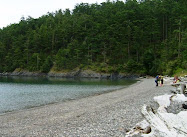
From the put-in beach, the northward panorama encompasses Hope and Skagit Islands, both Washington State Parks with primitive campsites. Northern Whidbey Island stretches forest green on the western horizon across the bay. On a sunny day it’s all blue sky and sea and forest-fringed islands, with glacier-encrusted Cascade volcanoe Mount Baker to the east.


I like to start by paddling north to Hope Island, then heading clockwise around the island along the shoreline. On the southern side, I scan the trees above the exposed rock faces for peregrine falcons or bald eagles, which I’ve seen frequently here.

Crossing around the western tip of the island, I’m always cautious and careful because strong currents and rip tides here can be dangerous and even cause a capsize—so I stay very close to shoreline.


On the north side of Hope Island, the vegetation is more mossy and lush, and creeps closer to the waterline. I mosey east along the shoreline past protected little coves and tangled bull kelp forests swaying on the water surface. Often we stop at a pretty little beach on the northwest side of the island for a break.


From about mid-island, I usually cut north and cross over to Skagit Island about a ½ mile away. Directly north, Mt. Erie on Fidalgo Island rises like a big round lump of granite dough.


When I get about even with Skagit Island, the Deception Pass Bridge is visible off to the west. That’s where the real action is, with huge whirlpools and swift, strong currents running through the pass.


But instead I turn right along the north side of Skagit Island and pull up to the broad cobble beach at the island’s eastern tip—a great place for a lunch break. The highlight at this little campsite: a compost toilet.


From here I head back south, either skirting along the eastern bay shoreline, or scooting back across to Hope Island. For a longer day, you can also head back west along the south side of Skagit Island and scoot over to Cornet Bay on Whidbey (part of Deception Pass State Park).

If the tide isn’t out too far and I’m not ready to quit, I’ll continue south to Dead Man’s Island for a loop around before landing back at Snee-Oosh Beach.


It’s not just the great paddling that draws me to Skagit Bay. There’s also plenty of good eats on the way home.

After a good day paddling, sometimes we stop at cozy La Conner Brewing Company on First Street for good beer and over-roasted pizza. Heading back through Conway, Snow Goose Produce is a must stop.


Local, organically grown produce is often half the price here of what you’d pay at farmer’s markets in the Seattle area. In the summer, they sell wild spot prawns from the San Juan Islands and fresh, wild salmon.

Good kayaking and good food. It’s just life in the Northwest!

When You Go
Check the tide charts for your arrival time at Skagit Bay since the southeast side of the bay is a mudflat at low tide. (It’s not fun carrying kayaks through sticky, mucky mudflats to get to the water.)