Wednesday, April 20, 2016

Northwest Reflections: Changing Seattle

When I graduated from University of Washington in Seattle many years ago, I packed up my car, invited a friend to join, and drove across the country. I couldn't wait to start post-college life on the East Coast.

The Northwest (Seattle and Portland, my hemisphere) felt like such a backwater after I'd had a taste of Paris, London, and New York. While traveling through Europe after spring quarter abroad, I had to explain to Europeans that Seattle and Portland were on the west coast of the United States, "north of San Francisco."

Times sure have changed.

Today Seattle is experiencing explosive growth, and people are pouring in from all over. Almost every day I meet fresh young faces (and some middle-aged) who have moved here in the last few months or years. Many don't even know anyone here when they arrive.

Besides techies (Amazon, Microsoft, Expedia, etc.), I'm meeting newly transplanted baristas, hairdressers, sales clerks, poets (okay, baristas and sales clerks :), many of whom live in shared housing because this city is so expensive.

To say that Seattle is experiencing growing pains is an understatement. 

Some joke that Seattle's new city bird is the crane.
 
The Not So Good
Our major roads and highways are clogged much of each day with crazy-making traffic, and our developing transit system will take well over a decade to catch up with demand. The City isn't managing its growth all that well. The cost of living is shooting skyward (the median Seattle income is less than the income estimated to maintain a comfortable life here), squeezing out the lower and middle classes. Charming and quirky low-rise buildings and homes are being torn down and replaced with often not-so-charming big boxes. The pollutant load into our waters is growing. And the list goes on.

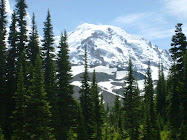
As a Seattle-born, Portland-raised, lived-in-the-Northwest-most-of-my-life gal (I lasted less than 3 years on the East Coast; I needed REAL mountains nearby), I'm finding all this rapid change unsettling. Our wonderful corner of the world, which I didn't fully appreciate fresh out of college, is totally discovered. 
 
On the map. The word is out.

(Lest I be insensitive, my sympathies to the native peoples who lived here for millennia before us European-American interlopers arrived and mostly destroyed their world/lifeways. My ancestors only landed here 148 years ago.)


Pioneer Square, Seattle

It's inevitable that cities change, evolve, grow or shrink, look different than they did 50, 100 years ago.  Everything is constantly changing. That's life on Planet Earth.

While the change has been building, seemingly overnight it feels...different around here. 

Often I hear people refer to "Pike's Market" instead of Pike Place Market.  Or radio announcers tell us to take "the 405" (CaliforniaSpeak) instead of just 405

It's much harder to find relative solitude in nature on the most beautiful and relatively close-in hikes in the Cascades on a weekend. It's often a steady stream of humanity and dogs on popular trails, sometimes with music blaring from an Ipod attached to a belt or pack. Litter (wrappers, food, etc.) is increasingly common along the trail. Parking at the trailhead? Good luck if you arrive after about 8 a.m.


I have to admit this rapid growth is starting to bother me. Mostly it's the traffic and crowds; our infrastructure isn't in place yet to sustain the quickly rising population. But I don't like hearing myself sound like a cranky curmudgeon. 

The Good
Change keeps us fresh and alive. With all the influx of talent and energy, there's a vibrancy in the region that's new. Wonderful restaurants and cafes, scads of great little coffee shops/bakeries, and lots of cool bicycle shops are opening around the city.

Coyle's Bakeshop, Greenwood neighborhood
More money is being funneled into the arts (although there have been some recent gallery/venue closures that are disappointing). There's a convergence of ideas, music, food, and theater that's exciting. At the opera this season I noticed more Millennials in addition to the usual gray-haired elders. This is good for the future of Seattle Opera.

And the Seahawks! When we went to the Super Bowl after the 2005 season, the national media treated us like Seattle was in a foreign country. In 2014, much different story. We're cool now!


Many of my good friends migrated to the region from places like Pennsylvania, Illinois, New Mexico, Michigan, and California. My life wouldn't be as rich without them to share local adventures and good conversation over coffee/tea/meals.

Some like UrbanVisions, a sustainable real estate development firm with an environmental/green ethic, are re-imagining the city with creativity, vision, and energy. Because growth is happening and will continue. (We just wish everyone had the same vision)

And despite it all, on most days I still usually feel like this living in the city of my birth:


So please, if you catch me kvetching (a very un-Seattle word) too much about traffic or crowds on the trail, give me a gentle nudge. Seattle and the whole region needs our thoughtful input on maintaining livability with the crazy growth. Complaining only goes so far; constructive criticism is better.

As Bob says:

 You'd better start swimming or you'll sink like a stone
'Cause the times, they are a-changin'....

How about you? (You really read all the way to the end here?)

Are you a lifelong Northwesterner? Moved here recently or years ago? What do you think about the changing Seattle/Northwest? Millennials, does it look different from your perspective?

I'm truly interested in hearing what you have to say. Jump in with a comment below!


Happy trails and thanks for visiting Pacific Northwest Seasons! In between blog posts, visit Pacific NW Seasons on FaceBook, Twitter, and Instagram for more Northwest photos and outdoors news.  
  
Bainbridge-bound ferry from downtown Seattle's Colman Dock ferry terminal
Bring back Galaxy Gold, the Space Needle's original color!

Make Your Voice Heard
There are some big plans in the works that will shape the future of Seattle/the region. While the Seattle Comprehensive Plan Update has already been drafted and the comment period is closed, there will still be opportunities for public involvement through 2016. Sound Transit, the Puget Sound region's light rail transit agency, is putting together a major funding initiative (ST3) for the fall 2016 vote. For more information and ways to get involved, click here.


Friday, April 8, 2016

Hiking the Cascade Foothills: Lime Kiln Trail


In my adrenaline-seeking, motor mouse youth, hiking was all about the alpine high country and gaining as much elevation as my sturdy and (then) injury-free legs could tramp

Now I'm having fun discovering lower-elevation hikes around western Washington. I can appreciate a beautiful lowland forest as much as the sweeping mountain panoramas high in the Cascades and Olympics. 

With a normal snowpack in the Pacific Northwest mountains this year (thank goodness!), lower elevations offer the best conditions for spring season hiking. Think abundant fresh moss, early season wildflowers, and rushing rivers and streams.
   
While hundreds (thousands?) of Seattle-area hikers head east up the I-90 corridor on weekends, I wanted to go somewhere a little farther and less popular for an early April hike I was organizing. On the Washington Trails Association website, the Lime Kiln Trail in the Robe Valley Historic Park near Granite Falls, Washington, sounded perfect.

Besides the beautiful scenery, this trail offers a trip past some of the region's logging and mining history. It follows the route of the historic former Everett & Monte Cristo Railroad that was active from the 1890s-1930s. Along the way, the trail passes an old lime kiln and the site of a former logging camp.

Saw blade from former Cavanaugh lumber mill.

Hiking this area especially appealed to me because a spur of the historic railroad passed close to nearby Hidden Valley Camp, where I was a camper for several summers. Camp founder Harry Truman used to enthrall us kids around the campfire with his story of the Old Ghost Railroad.

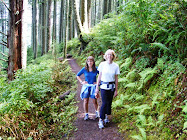
We arrived at the trailhead just outside Granite Falls about 8:15 a.m. Already several cars were in the lot and a group of hikers were gearing up.  As we started up the trail through second-growth forest thick with hanging moss, a lovely morning mist softened the air.


Basically the trail is pretty mellow, with a total elevation gain of about 650 feet over 7-ish miles out and back. After the first stretch through the mossy forest, the trail travels along an open, shrub-lined path for a mile or so until it narrows in the woods, skirting easy-to-miss Hubbard Lake.

It's not until you reach the Lime Kiln Trail cutoff that the landscape becomes especially enchanting.

Here the trail moves back into moss-encrusted forest and down a lush ravine toward the South Fork Stillaguamish River, then traverses the slope above the river for over a mile.

 
On this day, the "Stilly" was a lovely opaque green, flush with the beginning of spring runoff and recent heavy rain. 

For the next mile or so, the trail stays high above the river, passing through healthy second-growth forest thick with moss. The lime kiln right beside the trail is obvious, but watch for the logging camp sign. 

A century or more ago this area was all clearcut and bustling with loggers, the railroad, and the lime kiln operation. Today it's hard to imagine what it was like back then.


Instead the regenerated forest is thick with underbrush and vigorous growth.


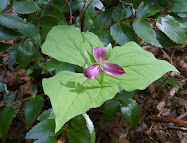
Trillium!

Eventually we reach a sign for the Rock Shore Loop or the railroad bridge site, and opt for the rock shore. Really it's all one loop so you can go either way.

From here the trail descends to the river, and we scrambled out on the rocky "beach" along with a couple dozen other hikers. (So much for the solitude, but it's beautiful.)


Swift spring river.
After a break, we hiked back up to the end of the trail, where the remnant concrete base of the former bridge is still visible.

I don't recommend climbing down to the river here because the trail is steep, crumbling, and hikers are no doubt hastening the erosion. But when my hiking buddies scrambled down, I couldn't just sit above and wait...okay, I suppose I could have. But I didn't.


And then we backtracked back to the trailhead, passing a multitude of hikers who have also discovered this splendid hike.

After Hike Eats
After hiking and scrambling, we stopped in Granite Falls for a bite before heading back to Seattle.  We dined at Omega Pizza & Pasta, situated in an old brick building dating to 1921. You can't miss it driving through Granite Falls.

The service was exceptionally friendly, the salads were large, tasty, and filling (couldn't finish my gyros salad), and in back there's a mural painted by Lake Stevens native son and Hollywood star Chris Pratt that's become a bit of a tourist draw.


Happy trails and thanks for visiting Pacific Northwest Seasons! In between blog posts, visit Pacific NW Seasons on FaceBook, Twitter, and Instagram for more Northwest photos and outdoors news.  

When You Go
Scroll down to the end of the WTA website hike description for driving directions to the trailhead and a map. We left north Seattle about 7:30 on a weekend morning and got to the trailhead in a little less than an hourIf you go later or on a week day during rush hour,  the travel time easily could double.  This is not a difficult hike, but do come prepared for the weather and hiking in the woods. We encountered some muddy trail, so hiking boots are always a good idea.