Sunday, August 15, 2010

Stargazing with Rose City Astronomers: Rediscovering Wonder


When was the last time you saw a shooting star? Or just stopped to gaze at the stars on a dark night?

To me there’s nothing like lying on my back on a summer night with a sky full of stars above to bring wonder back into my life and put things into perspective. Our little planet is just one of billions and billions (insert Carl Sagan accent) in the universe. It’s humbling, awe-inspiring, and, when you do see a flash of light blazing across the sky in the blink of an eye, breathtaking.

I’m still floating on the high of my night and early morning with Rose City Astronomers (RCA) watching the Perseid meteor showers, which peak in early-mid August every year in the northern hemisphere. And this year the almost-new moon conveniently slides below the horizon just after sunset for a darker sky.


Star parties aren’t just for Hollywood glitterati. With windows down to let in the warm evening air, I drive east from Portland on Interstate 84 up the Columbia River Gorge to Rooster Rock State Park for the annual RCA and OMSI (Oregon Museum of Science and Industry) Perseid star party. I get there about 9:20 as the western horizon is turning shades of crimson-orange and the stars are just starting to emerge.


Right along the riverbank telescopes of various shapes and size are set up. The most impressive is the reflector telescope that Robert McGown of RCA has set up. A tall, friendly man, Bob patiently answers questions about the telescope and the night sky as people wander by.


By 10 p.m. night has fully descended and the gauzy white Milky Way is visible running north-south above us, against a backdrop of stars bright and dim sprinkled across the sky. Living in Seattle, I can’t remember the last time I saw the Milky Way!

Bob excitedly points out a constellation low on the southern horizon in the shape of a teapot, if you use your imagination to connect the dots (uh, stars). “There’s Sagittarius! That’s one of my favorites.” I love that a long-time stargazer still gets pumped about spotting things in the night sky.

He then points to the really bright star directly overhead, Vega, which is part of the Lyra constellation. As Bob tells me the Greek myth about Lyra, I remember the sky is full of stories that stretch thousands of years back in human history. It makes me feel connected to the ancient Greeks, Arabs, and the whole of humanity over the millennia who have looked up at the night sky in wonder.

“Whooooaaa!” I cry along with several other people as we see our first meteor slip quickly across the sky. A thin white line pierces the black sky and disappears just as quickly. Did I really see that? Over the next hour I count about 15, although I miss several. You can always tell when you miss one because somebody else sees it and whoops or gasps and cries “Wow! Did you see that?”

About 11 p.m. I leave to get a few hours of sleep before my star-gazing continues predawn. Another RCA board member has invited me to join him atop Rocky Butte, an extinct volcanic cinder cone in northeast Portland, to catch the early morning show and sunrise.


Although the alarm goes off at 3:55, by the time I meet Matt at Rocky Butte, the sky is already beginning to lighten toward the long, slow summer dawn. I can barely make out the pointed silhouette of Mt. Hood on the eastern horizon just a tad south of us. We lay out pillows, blankets, and sleeping bags and lie down to watch the sunrise. About four meteors streak across the sky as we’re watching.


I do notice constellations that weren’t visible last night. Orion the Hunter with his three-star belt lies sideways in the eastern sky, pointing up to the Pleiades star cluster, which we can still see for a while before it gets too light.

With elegant Mt. Hood to the east, the Cascade foothills and Columbia River below, Mt. St. Helens to the north, and the Portland-Vancouver area spread out below us, it’s a stunning vista as the sky turns from dark blue to pink to orange to daylight.


What a way to start the day!

When You Go
RCA sponsors numerous lectures and star parties throughout the year, some east of the Cascades where there’s less light pollution. In the Seattle area, the Seattle Astronomical Society sponsors regular lectures and events as well. In Spokane, check out the Spokane Astronomical Society. Go meet some geeks and learn a lot. (I refer to geeks with affection, not mocking! Those guys and gals are a font of information.) If you’re in the Portland area and want to learn more about things astronomical, such as the lore, history, and techniques to locate stars and galaxies or even telescope-making techniques, Bob McGown offers classes. Email him at mcgownrobert@gmail.com.

And ladies, I recommend grabbing your sweetie or guy friend to join you for the Rocky Butte sunrise rather than going alone. You never know who else might be out there. When we got there we saw a jogger, a guy with his tripod set up to photograph the sunrise, and a couple who had a screaming fight in a car below us.

Wednesday, August 4, 2010

Weekend at the Lake

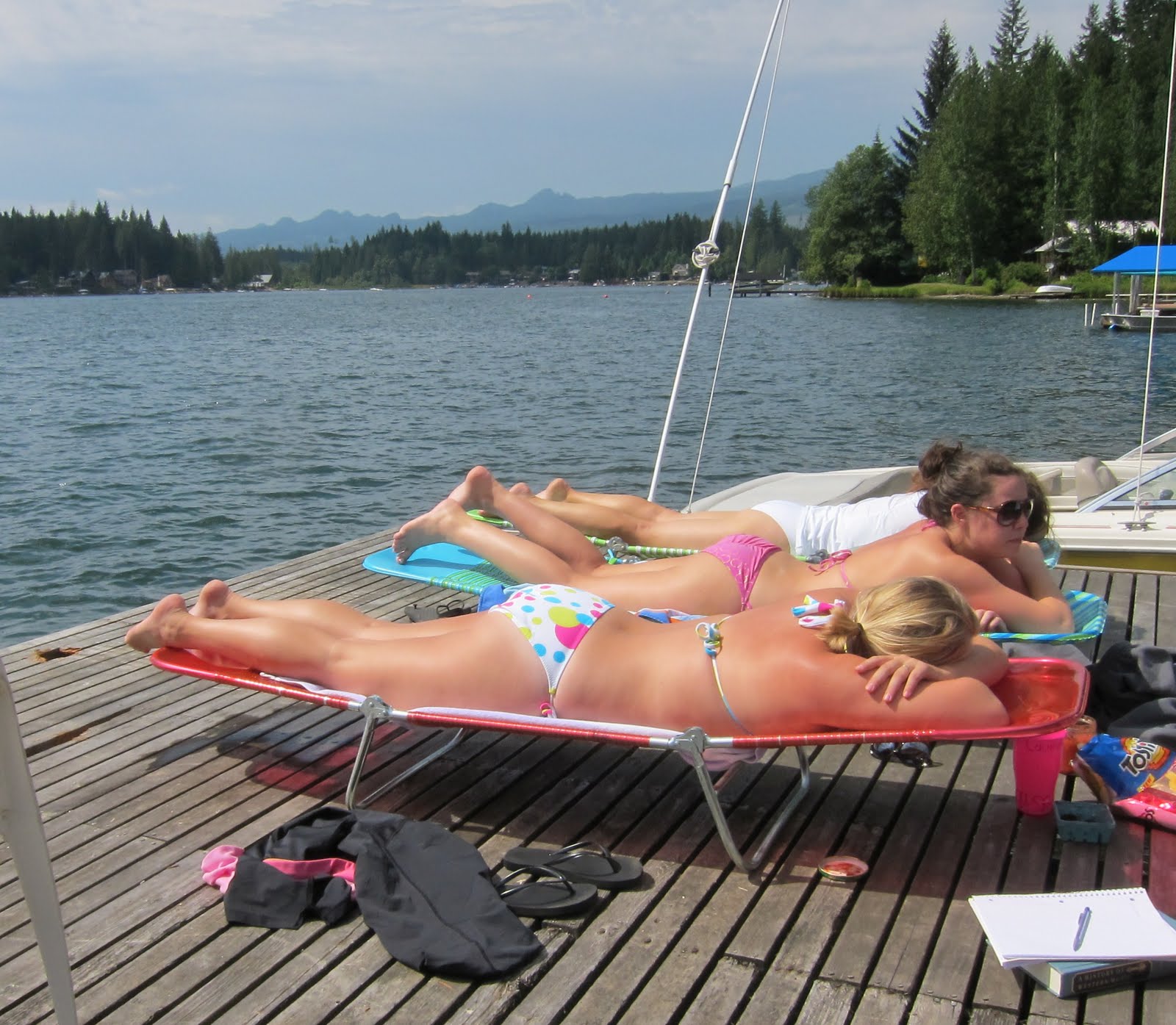
Across the Pacific Northwest and America, summer weekends for some involve a beloved ritual: packing up and heading to the lake (or island) house for the weekend. Are you one of the lucky few to have such a house in your family?

I’m not, but I am fortunate to have friends who do and who graciously invite me to join them now and then. I always try to be a helpful, fun, and pleasant guest.

I just spent the weekend at a lake in the Cascade foothills with some friends—a lake that has transformed dramatically since my first trip there when I was 9. Back then the scattered cabins were small and rustic, and deep evergreen forest fringed much of the shoreline.

Not so much today.


But it’s still beautiful.


Coming to the lake is a throwback to my water-skiing, sunbathing youth. In the intervening years I’ve trended more backpacking-kayaking camper, out howling for wolves, sitting Zen, or seeking solitude on craggy mountain peaks on the weekends. But that doesn’t mean I don’t like to mix it up. I’m thrilled to get another invite to hang out with these friends and cruise fast across the lake surface in a speedy little ski boat.


Who doesn’t love playing in the water on a sunny summer day?


Some head to their weekend getaways for quiet, some head to party, but everyone goes to relax. (Well, maybe the kids and teenagers aren’t looking for relaxation.)


Since this is America, dinner on these weekends is often barbeque. Tonight we have grilled chicken and flank steak for 12. Then there’s an evening boat ride to a party across the lake. And later, dancing. (I have some pretty fun friends.)


But my favorite time is still the evening and early morning quiet, when the wind dies down, people settle down, and the beauty of the surroundings move forefront.


I hope you’re also fortunate enough to have a few summer weekend getaways in a beautiful setting with good friends.

Sunday, July 25, 2010

Tacoma’s Museum of Glass: World Class

Ever think of museums as static, slightly boring places?

Down on the Thea Foss Waterway in Tacoma, in a scenic post-industrial setting, the Museum of Glass is many things, but certainly not boring. It’s a dynamic, education-focused place with mind-bending glass art, videos, glass blowing demonstrations, a great café and store, and, occasionally, karaoke in “the cone.”

With Tacoma-born celebrity glass artist Dale Chihuly and the Pilchuck Glass School leading the charge, the Pacific Northwest studio glass art scene vaulted onto the world stage in the early 1980s. Since then, visiting and aspiring glass artists have been drawn to our region. What better way to celebrate our glass art than spending an afternoon at the Museum of Glass?


For my sister’s birthday, we take a family field trip there for lunch, exploring and hitting the afternoon show in the Hot Shop (the cone structure that houses an amphitheater for glass blowing demonstrations).

It’s a gorgeous sunny July day, so we grab lunch in Gallucci's Glass Café and eat outside on the spacious patio overlooking the waterway. Sandwiches, pasta, and salads are all pretty good, but we decide my sister’s pasta dish is the tastiest.


I stroll down to the waterway for a look. The overall setting is a stunning marriage of a revitalized, formerly industrial waterway, public art, brilliant use of open space, and architectural savvy. I hate to sound like a snob, but it’s hard to believe we’re in Tacoma and not somewhere more cosmopolitan. Wait–I guess that means Tacoma is cosmo!


I’m excited to see the Preston Singletary exhibit. I’ve seen and been inspired by his work, which fuses his Northwest Coast Indian (Tlingit) heritage with contemporary art in glass. In the main gallery, we browse past his beautifully rendered pieces that replicate traditional Tlingit art forms in glass. Classic masks, cedar-bark hats, argillite bowls, bent wood boxes, and baskets are all here, but luminously transformed by the medium. (Photos not allowed in the exhibit but here’s a “basket” in the gift shop.)


Of course we have to cruise through the gift shop, where the offerings range from relatively inexpensive hand-blown glass orbs to pieces by various glass artists.


Then we head across the open lobby to the Hot Shop inside the 90-foot-tall cone for the afternoon glassmaking demonstration in this state-of-the art glass-blowing studio. This week’s visiting artist is Richard Craig Meitner, all the way from the Netherlands.


While the Hot Shop team glass artists expertly move molten hot glass on the end of metal rod in and out of the glowing red ovens, our fun interpreter Heather Cornelius warms up the crowd. “Who’d like to sing along to the music?” she says, waving the microphone in hand.


A woman in the row in front of me volunteers, and lucky her. After she warbles out a few a lines of “I love Rock ‘n Roll,” with the audience clapping and guest artist Richard dancing along, she is presented with a hand-blown goblet. (Note to self –next time I go, be brave and volunteer!)

After about 30 minutes of careful glass work, watching the glowing red orb of glass at the end of the rod get larger and larger, Heather tells us the excitement is about to pick up.


We watch rapt as Ben plunges the rod back into the oven, moves in close, starts spinning. Suddenly the globe flattens out to a large disc. He pulls it out, Alex makes a precise hit, and Gabe, dressed like an astronaut out for a lunar walk, grabs the disc with gloved mitts and walks quickly over to a cooling rack. Viola!


Since it is a beautiful afternoon, we shuffle out to go cross the Chihuly Bridge of Glass that spans a highway and railroad tracks between the Museum of Glass and the Washington State History Museum, next to the old Union train station. The bridge is of full of gorgeous glass pieces beside and above us.


We spent about three hours at the museum, but you could make it a longer day. Rent kayaks and explore the waterway, visit the State History Museum and Tacoma Art Museum, or walk along the waterfront.

When You Go
Click here for directions and parking information. The museum is open seven days a week, 10 a.m. to 5 p.m. Monday through Saturdays, noon to 5 p.m. on Sundays. We parked in the garage beneath the museum. Admission of $12 for an adult, but free the third Thursday of each month from 5 to 8 p.m.

Sunday, July 11, 2010

Zen Dog Studio Teahouse: Please Pour More Pu-er


I’ve just become a convert.

Unlike my brief stint at Bible camp where I was the only kid who didn’t cry from the spirit of Jesus (“What’s wrong with me?” I asked the counselor), I’ve been moved to tears by sipping a beautifully crafted, complex Purple Tip pu-er tea at Zen Dog Studio Teahouse in Seattle’s Crown Hill neighborhood.

Since I first blogged about Zen Dog a year and a half ago, I’ve spent many hours here, sipping tea with Zen Dog tea master Larry Murphy, trying his different teas, having great conversations. He has become a treasured friend, and he’s introduced me to others here who have also become my friends. And I bring my friends here. Call it tea love.

At first all I wanted was jasmine pearl, a refined but familiar floral green tea. Then I slowly worked through various oolongs—a richer, fermented tea—and recently settled on the Zen Dog House Roast as my new favorite tea I take home for my morning pot. (Larry roasts this oolong in his upstairs studio, which releases a heavenly aroma.)


But I initially resisted pu-er (also spelled puerh), which Bon Appetit magazine called “the tea for coffee lovers” because of its rich, strong, earthy flavor compared to many teas. Never been a coffee drinker myself.

Today we’re sitting in front of Larry’s alter to tea, a shiny, smooth camphor wood table as he carefully unwraps the aged brick of tea and slices off a bit for brewing.


“This tea is from a 500-year-old tree in Yunnan Province,” says Larry. He gets his fine teas from small estates in southern China, where tea growing and processing is a high art.


While outside it’s almost 90 degrees, inside Larry heats the pure water he’s collected from a local artesian well to a light boil. With the front door open to let in the breeze, we hear wind chimes bump against each other, ringing softly.

As we wait a moment for the tea to steep, Larry tells us “Pu-er opens the heart.” Have I perhaps been afraid of this tea unleashing my tightly held emotions?

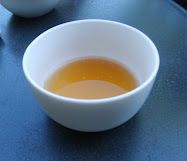
After pouring the first brew over a fat little ceramic Buddha on the table, we sip the next deep amber brew from small brown Yixiang clay cups. When she finishes her first cup, Jillian exclaims, “What a quick hit!”


Larry leans back and smiles. “This tea is so light it almost disappears and vaporizes on the tongue. It’s effervescent, silky smooth.”

I’m just surprised that I like what I taste. The tea is light and smooth, not bitter or astringent like I’d expected. But underneath the pleasant taste lurks a mysterious, ungraspable something else. It’s of the earth, but also sunshine and rain and the sea. There’s more. I can’t pin it down.

“This is good stuff!” I say with a smile.

Pu-er is prized in China, and Americans are just starting to become aware of it. And like a fine aged wine, a premium pu-er from a wild and ancient tree that has been processed and stored well is expensive and much sought after by tea connoisseurs. People even buy pu-er as an investment.

We sip multiple brews from the same tea leaves, talking, laughing, then being quiet and noticing the sensations in our mouth and body that this tea evokes.


“I’m feeling a direct connection to Qi, the universal life force,” says Larry. “There’s more energy with this pu-er (a 2004 brick) than the 2007, but there’s also a deep stillness.”

I know what he means.

Jillian and I feel it in the back of our throats, and then I feel a tingling around my nose and forehead. “The third eye,” says Larry.

I consider myself a pragmatist in general, but as I’m driving home I suddenly feel a tightening in the back of my throat. Then tears start forming in my eyes. I’m not thinking about anything in particular, but I feel moved.

Is this the heart-opening from pu-er that Larry talks about?

With surprise, I realize it must be. Tea!

When You Go
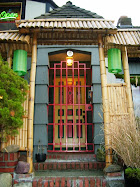
Zen Dog Studio Teahouse is on 85th Street in Crown Hill, about 6 blocks west of 15th Avenue Northwest. Look for the big Chinese lanterns hanging in the trees and bushes around the house. We drank the 2004 purple-tip pu-er. If you’re not in Seattle, you can buy Zen Dog’s tea online.

Monday, July 5, 2010

Kayaking to Yellow Island: Wildflowers and Solitude

One of the many things I love about sea kayaking in Washington’s San Juan Islands is paddling past scenic little islands clustered close together. One of my favorite places for island hopping is the Wasp Islands within the greater San Juan archipelago.

Sandwiched between large San Juan Island to the southwest and Orcas to the north, the Wasps are somewhat protected from the strong currents and southerly and northerly winds that blow through the region. (Although not completely protected, of course.)

During a recent weekend trip to Orcas Island, we paddled out to Yellow Island on the western edge of the Wasp Islands. This grassy, 11-acre island is a Nature Conservancy preserve famous for its brilliant display of native wildflowers each April and May. I haven’t made it there at the peak of wildflower season yet, but over Memorial Day enough flowers were still out for a lovely display.


Like most of the San Juan Islands, the Wasps are rocky outcrops covered with mixed forest of conifers such as Douglas fir, deciduous trees like big-leaf maples, and evergreen madrones. However, Yellow Island is a notable exception. It’s about the only island that was never grazed by livestock, leaving the native vegetation relatively free of invasive and non-natives. Ethnobotanists believe that the local Indians periodically cleared the island with burns to promote the growth of camas root, which was an important food source.

The day we kayak to Yellow Island, pewter gray skies, a smattering of rain, and a steady wind from the west keep things interesting (but not too exciting). We take off from the marina in Deer Harbor, where for a fee you can launch and use the hose at the dock to clean up afterwards. (For a longer trip, many kayakers camp overnight at nearby Jones Island and pass through the Wasps as a side trip.)

After scooting under the dock and out beyond the marina, we paddle about 20 to 25 minutes southwest out of the harbor until we reach Reef Island, watching out for motorboat traffic as we cross North Pass. Within the reefs and rock outcrops, we seek protection from the wind.


Passing along a rocky shoreline, I spy a little furry mammal scurrying up and out of sight. I think it’s a weasel, but Rich guessed wild mink. He’s right.

We stop for lunch at a beach on the west side of McConnell Island, making sure to stay below the tide line since most of the island shorelines are privately owned. As we munch, right across the passage just a quarter mile or so southwest is Yellow Island. We grab lunch now because we’ve heard food isn’t allowed on Yellow Island to prevent contaminating its fragile ecosystem.


As we head to the landing beach just below the wooden cabin on the south side of the Yellow Island, a group of kayakers is leaving. Only six visitors are allowed on the island between 10 a.m. and 4 p.m. Whew! Good timing. Unfortunately the tide is out and the landing beach is nasty, full of large rocks covered with slick wet seaweed.

Within a couple minutes of our arrival, Nature Conservancy steward Phil Green comes down to greet us as we’re moving our kayaks above the waterline. He’s bundled up in a fleece parka and knit cap, binoculars hanging down the front of his chest.


“Hi,” he says with a friendly smile. Phil’s face is pleasantly weathered with lines that crinkle around his eyes when he smiles, and a bit of gray stubble covers his chin. His demeanor is calm and relaxed. This is a man in tune with his environment.


Phil lives on the island in the equally weather-worn cabin, greeting visitors and carefully observing and noting the island’s flora and fauna. He’s also a font of information. “See those flattened areas of grass?” he asks when we’re near the top of the island on the loop trail. “That’s from otters. They breed here on the island. So do the wild mink.”

We don’t want to stay too long since we see another clump of dark clouds moving toward us from the west, so we walk quickly along the trail. Bright orange Indian paintbrush, wild Nootka roses, and numerous other late blooming wildflowers are sprinkled along the trail and meadows.


I wish we could linger longer. As we launch our kayaks back into the water, the wind has increased and we get swept quickly into the current.

Heading back, we angle east over to the Crane Island shoreline. On the north side of Crane, we’re out of the wind, and I continue to narrow Pole Pass between Crane and Orcas islands. On a map, Pole Pass is so tiny it looks like the waist of an hourglass.

It looks like an easy few strokes across the pass, but the current rips through here, squeezed by the narrow passage. We get carried back west a ways before we're completely clear of the current.


About 3 hours after we put in, we’re back at Deer Harbor. If it wasn’t windy and rainy, we would have stayed longer. But I’m happy. Any time I kayak in the San Juan Islands is a good time.

When You Go
Here is a map of the Wasp Islands, showing Yellow Island. Although the wildflowers peak in the spring, it’s still a worthwhile stop any time of year for the views and a chance to chat with Phil. Shearwater and other outfitters in the San Juans lead guided kayak trips to the Wasp Islands.