Sunday, December 13, 2009

Winter Walks in Carkeek Park: Relax and Enjoy the View.


With the chilly weather we’ve been having here in the Northwest, it’s easy to go into hibernation mode. Maybe it’s my Scandinavian blood, but I love being bundled up and outdoors moving in cold weather. Plus I need to burn off those extra calories from holiday meals and parties. (Ahem, don’t you, too?)

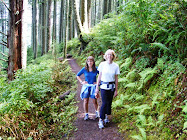
Today I hit the trail in my neighborhood treasure—Carkeek Park. With several miles of trails that wind up and down through second-growth forest, it’s easy to get a good workout and a sense of solitude here. And there are spectacular views of Puget Sound and the Olympics along the way.


I park down in the gully near Piper's Creek. So close to the winter solstice, the sun doesn’t rise high enough to melt the heavy frost that coats the ground down here. It looks like a light layer of sugary snow.


I pass my favorite western red cedar tree alongside Venema Creek, then head up a few switchbacks into the forest on the North trail. Although most of the big-leaf maples and alders are bare, bushy sword ferns and healthy patches of shiny-leafed salal still line the trail. When I lived in New England for a few years, I remember coming home one Christmas and being surprised at how green and verdant it was here in the winter.


On this cold weekday afternoon, I cross paths with just one jogger and her golden lab. My heart really gets pumping while I walk briskly uphill as the trail angles upwards and west toward the Sound. After about 15 minutes, I emerge from the forest into North Meadow.

If you don’t stop and relax here for a moment, you’ll miss a commemorative plaque embedded in the concrete at the foot of a bench.


This plaque always make me stop and smile. I wonder if these are words that John Sturgeon lived by. The view is lovely, with the Olympic Mountains rising ruggedly beyond the broad blue stretch of Puget Sound.


Then I plunge back into the forest and head down toward the beach.


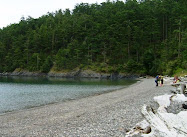
I always like to cross the pedestrian bridge over the railroad tracks that line the Sound and go down to the water’s edge on my Carkeek walks.


But first I stop at the top of the stairs leading down to the beach and take in the beautiful afternoon.


I love that we have these beautiful beaches here within the Seattle city limits.


Sometimes I see kite surfers here on windy days, but today the sea is calm.


For a few minutes I just stand and watch some bufflehead ducks dive and resurface close to shore, then it’s time to loop back to my car through the gully along Piper’s Creek.

When You Go
Carkeek Park, in northwest Seattle just beyond the northern edge of Ballard, encompasses three city streams that support a restored salmon run. Monthly volunteer trail and park maintenance parties meet the third Saturday of each month from 9 a.m. to noon.

Thursday, December 10, 2009

Green Lake's Pathway of Lights: A Seattle Holiday Tradition

Despite the frenzy of activity this time of year, I always make time for the Pathway of Lights around north Seattle's Green Lake. Join families, friends, and neighbors to walk the 2.8-mile path around the lake, taking in the warm glow of the luminaria. Bring your own lights and candles to add to the ambiance.

Click here to read about this event last year. Stay warm and enjoy the season!

When You Go
This year’s event will take place from 5:30 to 8:30 p.m. on Saturday evening, December 12, rain or shine. Admission is, as always, free.

Tuesday, December 1, 2009

College Football in the Northwest: Playing for Apples and Roses


Sure, the Northwest is full of hikers, foodies, and green-living latte sippers. But just like any region in America, we love our sports teams. If you really want to separate the region’s transplants from the true locals, follow the traffic jams to Husky, Reser (formerly Parker), Martin, or Autzen stadiums on a fall Saturday afternoon. (Or this week, Thursday night in Eugene.) You’ll find thousands of raucous fans cheering on their Huskies, Beavers, Ducks, or Cougars.

Although the national media gives more press to the Pac-10 California teams, here in the Northwest we have produced national championship teams (most recently the University of Washington Huskies). And this week the Oregon and Oregon State civil war game is for the Pac-10 Championship and Rose Bowl—a first!

The History
I’ll admit football doesn’t exactly fit my profile (the first sentence of this post sorta describes me). But Husky football is in my blood. It’s a family thing. I’m in the fourth of five generations of my family who have gone to the U Dub.

My dad took me to my first Husky game when I was a wee girl of 9. I was fussy and annoyed by the gruff, cigar-smoking man behind us. By junior high, though, I was hooked.

The Party
Last Saturday I went to the Apple Cup to watch the Huskies cream the Washington State University Cougars. As I followed the streaming crowd to the game, the buzz outside the stadium was palpable. Alumni from the Husky Marching Band gleefully performed “Louie Louie”—a Northwest classic—to get the fans pumped up. Huddled in a big circle and swaying with the music as they played, the musicians’ enthusiasm was infectious. (Unfortunately, a bill to change the Washington state song to Louie Louie didn’t pass in the state legislature.)

Then it was on to some tailgate parties, where I laughed and exchanged hugs with college friends I hadn’t seen in a while. “Want some of my beef stroganoff?” asked Carina. How lucky was I to stop by her tailgate for the one game of the year when she brings her signature dish? Very. (See her recipe below —thanks Carina!)

The Game
I’m not so much into the details of football. My favorite part of each game at Husky Stadium is when Dubs, the Malamute Husky mascot, comes bounding into the stadium ahead of the team before opening kickoff, tongue and tail wagging. And I love the view of Union Bay/Lake Washington out the east end of Husky Stadium, voted the most scenic stadium in college football.

So this year’s Apple Cup was a blowout, a 30-nothing win for the Dawgs. Governor Chris Gregoire (a UW grad herself) came onto the field after the game to present the huge Apple Cup trophy to the Huskies.

It’s all fun and crazy and silly. And I’ll do it again next season.

When You Go
Hey, you can still catch a game this Saturday at Husky Stadium when the Dawgs take on the California Golden Bears. The school is offering four free tickets to Saturday's game to all active police, military and fire department personnel — with applicable ID. Those interested can call or go to the Husky Ticket Office Monday-Friday during business hours, or the ticket window at the Northeast Plaza at Husky Stadium on Saturday. For info, call the UW ticket office at 206-543-2200. Or be sure to watch the Oregon Ducks and Oregon State Beavers play for the Pac-10 title!

Carina's Brothers' Favorite Beef Stroganoff

Buy 1-1/2 # pre-packaged flat iron steak and ask the butcher to cut it into ½” thick slices.

In large heavy pot, melt 1 T. butter (enough to coat bottom of pan) and brown the meat on all sides over medium heat.

Add 1-1/2 c. beef bouillon, ½ c. red wine, 1 t. salt, 2 T. ketchup, 1 clove minced garlic. Bring to a boil and then turn heat down to low simmer and cover. Cook until meat is tender (about 1-1/2 to 2 hours).

Add one whole, finely minced yellow onion (I use food processor to make sure it’s very fine). Cook on low simmer until onion is tender (20-30 minutes).

Place 3 T flour in a jar and add ¼ c. beef bouillon and ¼ c. red wine. Shake until smooth. Add slowly to the stroganoff and cook through on medium until sauce thickens (4-5 minutes). Turn heat to low and add 1/3 to ½ c. sour cream (depending on whether you want it to be more of a beef bourguignon (less) or creamier stroganoff (more). Do not boil after this or cream will curdle. Season to taste with salt and pepper.

Serve over hot pasta or rice. Best enjoyed with good friends and family.

Special thanks to Dubs' blog , where I got the photo of Dubs at 10 weeks old.

Sunday, November 22, 2009

Fresh, Fluffy, and Fast: Early Season Skiing at Crystal Mountain


An El Nino winter is staring us in the face here in the Northwest, with a predicted warmer, drier winter. Combined with global warming, for skiers that means one thing:

Carpe Diem!

With an unusually early start to the ski season, I grab my skis and head to the mountains today. How could I not? It snowed over 2 feet in the last two days at Crystal! As hard as it is to get up and get going before dawn on Sunday morning, I’m a skier deep in my bones. When the snow flies thick and fast, it’s time to move.

Although I started out life as a Mount Hood skier, and still love my mountain, Crystal stole my heart when I was a student at the University of Washington. My friend Linda got me better acquainted with Crystal after nights polka dancing and drinking homemade wine with those crazy Estonians at the Billiken Ski Club Lodge. My years teaching for the Crystal Mountain Ski School cemented my passion. This mountain is a treasure trove of off-piste chutes, gulleys, and groves for tree skiing.

So today I drive up with Andy, Mark, and Lena and meet Rich on the hill. We’re taking it easy today (except Rich) and warming up for the season ahead. A cold wind and driving snow blasts our faces as we take our first run down from Forest Queen. Although we get a mid-morning start, it’s snowing so hard that the cut-up snow is filling in fast. It’s cold, and the snow conditions are fabulous.
With the high winds, the High Campbell chair isn’t open, but Rich has some great runs up on Upper and Lower Bull. I’m happy to simply stay close to the trees and take cruisers down CMAC, Mr. Magoo, and Downhill (site of a World Cup downhill many years ago). And find the fluff on the sides of the runs where I can sneak in some fresh tracks.

So skiers, get on up to the Cascades and enjoy it while you can! If the weather guru Cliff Mass is right, by January it could dry up and we’ll be skiing on icy, scraped-off hard pack.

When You Go
Click here for directions to Crystal from Puget Sound region cities, and here for a conditions update. Since I didn’t get any really good pictures today, click here for some shots of Crystal in all its sun-filled glory.

Tuesday, November 3, 2009

Wolves in Washington: They’re Back! (and you can help them stay)

Have you ever heard a wild wolf howling in the night? This possibility is now real again in Washington for the first time since the 1930s. But my brief wolf story starts just over 15 years ago: With unconfirmed reports of gray wolves in Washington’s central Cascades in the early 1990s, it was time to get real proof. During the summer of 1993 I volunteered to participate in a wolf survey for the U. S. Forest Service’s Cle Elum Ranger District.

Based on sighting reports, a very enthusiastic Forest Service wildlife biologist trained a group of willing hikers/tree huggers (self included) in wolf survey protocols. On six weekends spread over the summer, we camped above a remote, larch-filled canyon on Table Mountain above Ellensburg and took turns howling for wolves at different designated “stations” along the rim.

OWWWWOOOOO! OWOOOOOOOOO!!

Yes, wolves do howl back to humans if you can fake a good howl. We didn’t get any responses that summer, but I still remember vividly the excitement of the possibility. I loved those warm summer nights. We hiked through subalpine forests to our howling stations, sometimes with just the full silver moon illuminating our way.

Fast forward 16 years. There are now two confirmed breeding pairs of wolves in Washington—one pack is now in the Okanogan region of north-central Washington (the Lookout pack), and another is in the northeast corner of the state (the Diamond pack). These animals have found their way back to Washington 70 years after being decimated by bounty hunters.

Last night I attended a public hearing at REI’s Seattle flagship store on the recently released Gray Wolf Conservation and Management Plan Environmental Impact Statement. The place was packed! Being Seattle, the crowd was heavily pro-wolf, but sprinkled here and there were a few hunters wearing old baseball caps and a few ranchers in HUGE cowboy hats. Did sparks fly?

Yea, a little bit. But we Northwesterners are generally a well-behaved bunch who prefer to avoid conflict. The hearing was one of several around the state sponsored by the Washington Department of Fish and Wildlife, who drafted the plan. Anyone and everyone were invited to take their turn and speak for a few minutes about the plan. I was too shy to take the microphone, but comments ranged from heartwarming fluff to substantive biologist opinions to impassioned and angry cattlemen who think any wolf is one too many. “If you’ve ever seen a baby calf that’s been torn apart by a wolf or coyote, it isn’t a pretty sight,” cried one rancher. “We work hard to raise these cattle. If I see a wolf attacking one, I’m going to do something about it.”

“I’ve seen wolf-kill, and it isn’t pretty,” said a woman later, who grew up on a ranch. “But,” she added “a slaughterhouse isn’t too pretty either.”

What YOU Can Do
The upshot of my rambling is this: Biologists I know tell me the plan’s recommendation of 15 breeding pairs to remove legal protection of wolves is not enough to sustain a healthy population. Most ranchers and hunters want a lower threshold. I'd like to think we can have a healthy wolf population and have it work for hunters and ranchers. If you want to see a healthy wolf population back in Washington, comment online here by January 15, 2010. Be as specific as you can when you comment. Wolves are native to the Northwest. They help restore balance to heal a damaged ecosystem, as evidenced in Yellowstone. Help heal the wolf population with your comments. Thanks for caring!

Special Thanks

The lone wolf photo above was taken by Gary Kramer of the U.S. Fish and Wildlife Service. The wolf pups are from the Lookout pack and that photo was taken from Conservation Northwest's webcam.

Saturday, October 17, 2009

Whidbey Island Afternoon: Hiking the bluff 'n beach at Ebey’s Landing


I’ve always loved going places I’ve never been before. Don’t you? Sure, I dream of exotic, far-flung adventures. But it could also be something as simple as driving down a different road in my neighborhood.

Even though I’ve lived here most of my life, there are still plenty corners of the Northwest I’ve yet to see. Recently I made my first trip to hike the shoreline bluff at Ebey’s Landing National Historic Reserve on the westernmost point of Whidbey Island. This wonderful spot on the western edge of Whidbey offers stunning views of the Olympic Peninsula, Strait of Juan de Fuca, San Juan Islands, and east and south to the Cascade Mountains. Best of all, you can do it year-round.


Getting there
On a partly cloudy, breezy Friday, we catch a mid-morning ferry from Mukilteo to Whidbey. After swinging through Langley to fuel up at Useless Bay Coffee, we head up island on Highway 20 (part of the Cascade Loop scenic drive).


Although traffic is thicker on the island than it used to be, it still feels like a trip back to a slower time. We pass through evergreen forests, sweeping vistas, and bucolic farmland. When we arrive at the reserve’s beach parking lot west of Coupeville, one spot is open, just for us. “I have good parking karma,” Shari tells me.

Hiking the bluff
Before we start, I dash to the beach and dip my toes in the breaking waves. Just because. A light but steady, salty sea breeze blows across my face, refreshing and invigorating.


Right away the trail heads up wooden steps through a tangle of native shrubs like snowberry and Nootka rose. Within 10 minutes, we’ve hit the bluff top, which then angles gently upward.


The trail skirts preserved historic farmland and drops off steeply to the beach below.


Like a ghostly mirage, Mount Baker and elusive Glacier Peak float on the eastern horizon above lesser Cascade peaks such as Whitehorse Mountain and Three Fingers. We meander north up the bluff, passing tidy fields of golden grain that roll gently in sinuous waves. Part of the purpose of the historical reserve is to preserve this farmland from development, thus maintaining farming that’s gone on here for over a century.


Another 10 minutes or so up the bluff we enter the Robert Y. Pratt Preserve, a Nature Conservancy property. The whole Ebey’s Landing complex is actually a patchwork of National Park Service, Nature Conservancy, state park, and conservation easement land.


“I especially like this hike because you pass through the interface of four distinct landscapes—the farmland, the bluff, the lagoon, and the beach,” says Elizabeth Davis, a friendly retiree volunteer we meet on the trail. (Elizabeth isn’t crazy about having her picture taken, but she obliges. I think she’s quite lovely.)


After gradually climbing upward along the bluff, we top out at the edge of a mature lowland forest. Some of the Douglas firs here are as old as 200 years. From here the trail winds through tall grasses along the edge of wind-stunted trees.


Several little trails wind into the inviting green forest, but none of them go very far. “Those aren’t official trails and we discourage people from using them. They don’t really go anywhere,” Elizabeth tells us.


Whoosh! A big osprey flies overhead and drops like a stone into the tall grass below me halfway down the bluff. I think of the poor field mouse that probably just met its demise.


Don hikes at a brisk pace, but I can’t keep from stopping often to gape at the wondrous views down to the lagoon, across the Strait, and north into the San Juans. With the bracing fresh air and the lovely, unspoiled setting, I want to linger longer.


As the bluff trails angles downward, we switchback and head down to the lagoon (Perego’s Lake). At Elizabeth’s recommendation, we walk back along the lagoon’s edge instead of the beach just yet.


Brown and white killdeer float in bunches along the water surface. The saltwater lagoon is home throughout the year to lots of migrating birds and waterfowl.

We hop over the driftwood protecting the lagoon and walk the beach the rest of the way back. Several times I almost stumble on flocks of small brown birds that blend a little too well into the sandy beach. Each time they burst upward and fly together in formation farther down the beach, peeping in alarm. We hopscotch together down the beach.


About 2 hours after we started, we’re back at the car. Overall we covered close to 3 miles and got a good stretch of the legs. Now we’re off to Langley for dinner.

When You Go
This Nature Conservancy page has a map and directions to the beach at Ebey’s Landing. We spent a little over 2 hours there, but you could easily spend a few more with binoculars and bird or native plant guide in hand, your camera and tripod, or a sketch pad. Click here to donate to the Nature Conservancy.

Tuesday, October 6, 2009

The View Point Inn: Not just a pretty view


Sadly, the View Point Inn burned in summer of 2011 and is still closed, possibly forever.

Today I’m taking my mom for a special birthday lunch. We’re dining at the historic View Point Inn, which sits perched high on a bluff near the western edge of the Columbia River Gorge National Scenic Area in Oregon. (For you Twilight fans, this is where Bella and Edward danced together under the stars at the Forks High School prom—about 200 miles from the real Forks, Washington.)

A Discovery

While driving up the old Columbia River Gorge Highway several years ago, I noticed a large gable-roofed building just past the cutoff to Larch Mountain. We stopped and discovered a vacant but charming 1920s-vintage villa. I immediately saw a diamond in the rough; with expansive lawns and steps leading down to an abandoned fountain in the garden, it just needed some polishing up.


I peered inside the multi-paned windows and saw a massive stone fireplace and wood floors. The view from the place was absolutely smashing—the Columbia River stretched west for miles toward the horizon, sprinkled with islands. The bluff below plunged hundreds of feet into a verdant green forest. What a gem!


After doing a little research, I discovered the property opened in 1924 as an inn. For several decades it drew fancy guests such as President Franklin D. Roosevelt, Hollywood stars, and European aristocrats until it closed and fell into disrepair. Now it's on the National Register of Historic Places.


A Fantasy
I fantasized about enlisting my chef friend Ed, fixing the place up, and reopening it as a destination restaurant. (Never mind that my only restaurant experience was a few months at a fish ‘n chips joint as a teenager.) It was set above my beloved Columbia Gorge, and I envisioned exciting possibilities for featuring local food. I even dreamt about it one night. A few years later I heard it finally opened again.


A Meal
So here we are on an early fall afternoon at a window table in the sun porch, overlooking the garden and panorama beyond. A starched white linen tablecloth covers the table, adorned with a sweet little cup of pink flowers and a sprig of rosemary from the garden. To get here we passed through the spacious main room, where a fire crackles in the rustic fireplace and the chandeliers glow warm. It has the feel of the classic old National Park lodges, like Paradise Inn on Mount Rainier, but on a smaller scale.


A glance at the menu shows a focus on local food and flavors. (Great minds think alike, right?) “Are the prawns from the Oregon coast?” I ask our very friendly and personable waiter. “Yes they are,” he replies. We split the prawn cocktail appetizer, the roasted breast of fowl (chicken today) with balsamic-drizzled greens and roasted fingerling potatoes, and order a side of crusty, fresh olive-flecked bread.


Although the chicken entree is quite good, the highlight of our meal is the tender but firm and flavorful prawns. After reading about the nasty environmental effects of shrimp and prawn farms in Southeast Asia, I only order fresh, local shrimp anymore. Fortunately here in the Northwest we can get wonderful wild spot prawns and baby shrimp.


A Walk in the Garden
After we polish off our lunch, it’s time for a stroll in the garden. Since the phenomenal success of the Twilight movie, this is now a regular stop for teenaged girls and other, mostly young women. We see some girls posing for photos beneath a remnant from the movie set in the garden–-a tall black portal that reads Monte Carlo Casino. (Or something like that.)

Lush herbs and flowers line the building, and elegant old concrete pots interspersed along the pathways sprout trailing greenery.


Neon orange carp loll beneath lily pads in the pond surrounding the restored fountain. Catching a whiff of late-blooming lavender, I linger here as my mom enjoys the view from the patio above.


As we’re leaving, a family is checking in for the night. This is, after all, an inn, with four rooms upstairs above the dining room. I want to come back and spend an evening curled up on one of the huge sofas in front of the fireplace with a good book. Thanksgiving weekend perhaps?

When You Go
The View Point Inn is just 22 miles east of Portland (click here for a map and directions). Call ahead for reservations. Although we didn’t have any trouble getting in for lunch on a Saturday, it might be a very different story around the holidays. Check out their special events here. Our lunch came to about $40 with tip, which included an appetizer, an entrée, a side of bread, and tea.

To make it an even more scenic trip, drive through downtown Troutdale, up the Sandy River Gorge, and through Springdale and Corbett, with a stop at the Portland Women’s Forum State Park (Chanticleer Point) for the spectacular view east up the Gorge. After your meal, continue on down the old Columbia River Highway past numerous waterfalls and stop to hike off your lunch at Wahkeena or Multnomah Falls. Also, the aging historic building still needs preservation work, so click here and scroll down the page to donate a dollar to help out.

Saturday, September 26, 2009

Kayaking the Black River: Rain, Ducks, and Guns


We’re driving south on I-5 through sheets of rain so thick you’d think it was a blizzard. “Wow, did you feel the car just hydroplane?” I gasp. Rich slows down.

Our destination is the Black River near Rochester, Washington, about 30 miles southwest of Olympia. Unfortunately we’ve chosen a day with some wild and whacky weather. “Hey, did you see that flash of lightning over to the east?” says Rich. Oh great, I think to myself.

“We’re really intrepid, aren’t we?” I say.

“Yea, or we’re really stupid,” replies Rich.

About 5 minutes later we see a break in the clouds and a patch of blue sky to the southwest, so we banish thoughts of bailing and forge on. “With our raingear on and sprayskirt over the cockpit, we can’t get that cold or wet, right?” says Rich. “Right,” I mumble, knowing full well I’ve gotten very cold and wet while kayaking in raingear before.

After exiting I-5 onto State Route 12, we drive about 5 miles west and find the unmarked gravel turnoff from Moon Road, where we park and launch.


Since the Black River’s main source is a lowland lake rather than snow melt from the mountains, it’s an easy year-round trip for canoers and sea kayakers. This is not where you go for whitewater action.

As we ease our sea kayaks into the placid river and head upstream, as if on cue the rain subsides and the sun streams through the clouds. (This is what Northwesterners call a sunbreak.)


Maybe we really will experience the “fairyland of butterflies and birds,” as a guidebook exuberantly described paddling here. In 1980, U. S. Fish and Wildlife Service identified the Black River as one of the most important fish and wildlife habitats in the state, so several miles of the valuable riparian habitat along the river are protected as a wildlife refuge.


We’re surrounded by green, gold, and a tinge of red on this early fall day. Alder, willow, red-osier dogwood, and a profusion of other trees and shrubs almost engulf the narrow river channel here. The unmistakable chatter of a belted kingfisher echoes upriver, and soon we see it swooping from tree to tree on the river’s edge just ahead of us.


Ten minutes later, Rich glances up at the bruised-looking sky and announces, “We’re in for some more rain soon.” Almost as quickly as the sun came out, the rains return. Up go our hoods, and sunglasses get stashed back into our pockets.

And so it goes for the next couple hours. We paddle past forested and pasture-lined river, passing a couple houses along the way and cruising under a railroad bridge. The downpours come and go. We get pretty wet, but it’s not that cold. The current is mild, although kayaking upstream does require a teensy bit of muscle.


I’d hardly call it a fairlyland, though. No butterflies and not that many birds, although we do see some ducks and a few great blue herons. Probably we’ve come too late (or early) in the season or all those creatures are hunkered down because of the rain, like we should be.

It’s peaceful and quiet here on the river until we suddenly hear gunshots. Close by.

“Shotgun,” says Rich, “for hunting waterfowl.”

As we loop around a tree-lined oxbow in the river, the shots get closer and louder, which makes me uncomfortable. Maybe we’ll get mistaken for oversized, Gore-tex clad geese.


“I don’t want to be a headline in the newspaper,” says Rich. He doesn’t need to explain, I can see the headline myself: KAYAKERS ACCIDENTALLY SHOT ON RIVER. So we turn around and head back downriver. The riverside scenery is getting more monotonous anyway the farther upriver we go.


Since we’re heading downstream now, we make better time and even shoot through a couple baby rapids, which is fun. At one point we’re surrounded by buff-bellied swallows flying in circles above and around us in quick speedy spurts. Those little birds move fast!

As we’re hauling our kayaks out of the river and loading up the car, we get a dose of the local wildlife— homo sapiens. Tires spin on gravel in the pullout just above us and a car door opens and slams shut. About 10 yards uphill a guy runs up to the closest fire hydrant, uh, tree and….

When You Go
Don’t go during the fall duck hunting season! To be fair, we hit the Black River on a pretty crummy day. This trip would be better as a one-way car shuttle trip with a couple vehicles, starting up river and paddling the 12 miles downriver to Oakville. And go when it’s not raining!